
Introduction
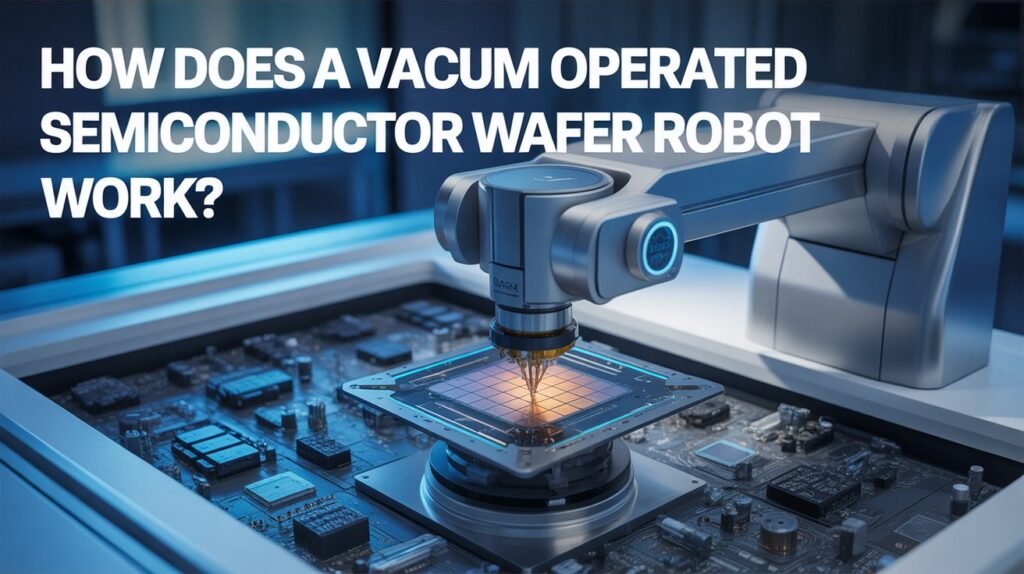
How Does a Vacuum Operated Semiconductor Wafer Robot Work? This is one of the most important questions in modern semiconductor manufacturing and industrial automation. These advanced robotic systems use precision vacuum suction technology to safely handle delicate silicon wafers during chip production. From wafer pickup and transportation to accurate placement inside cleanroom environments, vacuum operated wafer robots help manufacturers improve speed, reduce contamination, and increase production accuracy. In this guide, you will learn the complete working process, components, advantages, and real-world applications of semiconductor wafer handling robots.
Table of Contents
How Does a Vacuum Operated Semiconductor Wafer Robot Work?
A vacuum operated semiconductor wafer robot is an automated robotic handling system designed to pick, transport, align, and place silicon wafers during semiconductor fabrication.
Instead of using physical clamps, the robot uses vacuum suction pressure to hold wafers safely without damaging their surface.
These robots are commonly used in:
- Semiconductor fabrication plants
- Integrated circuit production
- Cleanroom automation systems
- Solar cell manufacturing
- MEMS production facilities
Their main purpose is to improve manufacturing precision, reduce contamination, and increase production speed.
Understanding Semiconductor Wafers
A semiconductor wafer is a thin circular silicon disc used to manufacture electronic chips and circuits.
These wafers are used in products such as:
- Smartphones
- Processors
- Graphics cards
- Memory chips
- Sensors
- Computer hardware
Because semiconductor wafers are fragile, manufacturers avoid manual handling whenever possible.
Why Wafer Handling Requires Vacuum Robots
Human handling creates several risks during semiconductor manufacturing.
These risks include:
- Dust contamination
- Fingerprints
- Static electricity damage
- Surface scratches
- Alignment errors
Vacuum operated wafer robots solve these issues by providing clean and precise automated wafer movement.
Many industrial vacuum systems depend on proper suction performance. Similar concepts are explained in How Much Suction Power Does a Vacuum Cleaner Need?.
How Does a Vacuum Operated Semiconductor Wafer Robot Work?
The working process of a vacuum operated semiconductor wafer robot involves multiple precision-controlled steps.
1. Wafer Position Detection
The robot first identifies the wafer location using advanced sensors and vision systems.
Common technologies include:
- Laser alignment systems
- Optical cameras
- Vision sensors
- Edge detection tools
These systems help the robot detect wafer orientation with extremely high precision.
2. Robotic Arm Movement
After locating the wafer, the robotic arm moves carefully toward the target position.
Most wafer robots use:
- Servo motors
- Linear actuators
- Multi-axis robotic movement systems
This allows stable movement with minimal vibration.
3. Vacuum Suction Activation
Once the robotic arm reaches the wafer, the vacuum system activates.
The end-effector generates negative pressure that gently lifts the wafer surface.
Common vacuum gripping systems include:
- Vacuum suction cups
- Bernoulli grippers
- Porous vacuum pads
This handling method helps prevent scratches and cracks.
Vacuum efficiency is important in every suction-based system. You can learn more in Fix Vacuum Cleaner No Suction Problem at Home.
4. Safe Wafer Transportation
After pickup, the robot transports the wafer to another manufacturing station.
These stations may include:
- Lithography systems
- Etching chambers
- Cleaning systems
- Inspection machines
- Packaging equipment
The robotic arm moves smoothly to avoid vibration damage.
5. Precise Wafer Placement
At the destination, the robot carefully positions the wafer and slowly releases vacuum pressure.
This ensures:
- Accurate placement
- Minimal contamination
- Proper alignment
- Safe wafer transfer
The entire process is fully automated and highly efficient.
Main Components of a Vacuum Operated Wafer Robot
Understanding the main components helps explain how the robotic system operates.
Robotic Arm
The robotic arm controls wafer movement throughout the manufacturing process.
Its functions include:
- Rotation
- Extension
- Positioning
- Automated transport
Modern robotic arms provide micron-level precision.
Vacuum End-Effector
The end-effector is the gripping tool attached to the robotic arm.
Its job is to:
- Generate suction
- Hold wafers securely
- Prevent contamination
- Reduce surface damage
Vacuum Pump System
The vacuum pump creates the suction force needed for wafer handling.
Common systems include:
- Dry vacuum pumps
- Oil-free pumps
- Pneumatic vacuum generators
Clean vacuum systems are critical because contamination can affect semiconductor quality. Dirty filtration systems can also reduce suction efficiency in vacuum-based equipment. Related information is available in Can Clogged Filter Damage Vacuum Cleaner?.
Sensors and Vision Systems
Advanced sensors help the robot detect:
- Wafer location
- Alignment position
- Surface orientation
- Movement accuracy
AI-based vision systems further improve manufacturing precision.
Motion Control System
The control system manages:
- Robotic movement
- Speed control
- Vacuum pressure
- Process automation
- Safety monitoring
Modern semiconductor factories often integrate these robots into smart manufacturing systems.
Advantages of Vacuum Operated Semiconductor Wafer Robots
These robots provide several major advantages in semiconductor production.
High Precision
Wafer robots can position wafers with extremely high accuracy.
Reduced Contamination
Vacuum handling minimizes human contact and contamination risks.
Faster Manufacturing
Automated wafer transport improves production speed and efficiency.
Lower Damage Risk
Vacuum suction reduces the chance of wafer cracking or scratching.
Improved Automation
These robots support fully automated semiconductor manufacturing systems.
Applications of Vacuum Operated Wafer Robots
These robotic systems are used in multiple industries.
Semiconductor Manufacturing
Used for automated wafer movement during chip production.
Solar Panel Manufacturing
Used to safely transport photovoltaic wafers.
MEMS Production
Supports manufacturing of microelectromechanical systems.
Electronics Industry
Used in precision electronics assembly and automated production systems.
Future of Semiconductor Wafer Robots
The future of semiconductor robotics is rapidly evolving.
Upcoming technologies include:
- Artificial intelligence
- Machine learning automation
- Predictive maintenance
- Smart factory integration
- Advanced robotic vision systems
As semiconductor manufacturing becomes more advanced, vacuum operated wafer robots will become even more important for high-speed precision production.
Conclusion
Vacuum operated semiconductor wafer robots are essential in modern semiconductor manufacturing. These advanced robotic systems use vacuum suction technology to safely move fragile silicon wafers without contamination or physical damage.
From wafer detection and vacuum pickup to transportation and placement, every process is designed for maximum precision and efficiency. As semiconductor technology continues to evolve, these robots will remain a critical part of automated chip manufacturing and advanced electronics production.
Understanding how a vacuum operated semiconductor wafer robot works also helps explain the sophisticated automation systems used behind modern processors, smartphones, computers, and electronic devices.
FAQs
What is a vacuum operated semiconductor wafer robot?
It is an automated robotic system that uses vacuum suction to safely handle semiconductor wafers during chip manufacturing.
Why is vacuum technology used for wafer handling?
Vacuum technology provides gentle, contamination-free wafer handling without damaging delicate silicon surfaces.
Where are semiconductor wafer robots used?
They are mainly used in semiconductor fabrication plants, solar manufacturing facilities, MEMS production, and electronics industries.
Can wafer robots operate inside vacuum chambers?
Yes. Many semiconductor wafer robots are specifically designed for vacuum chamber environments.
Are semiconductor wafer robots fully automated?
Most modern wafer robots are highly automated and integrated with advanced smart factory systems.