
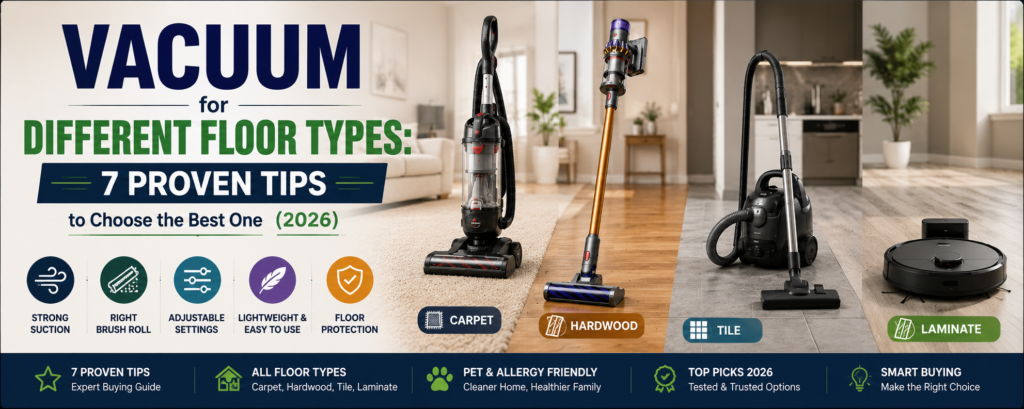
Introduction
Vacuum for Different Floor Types: You know the feeling. You buy a vacuum because it looked powerful in the ad, bring it home, and within a week your hardwood floors have faint scratch marks — or worse, the “powerful” suction barely lifts anything off your thick carpet. Sound familiar?
Here’s the truth nobody tells you at the store: there’s no such thing as a universally “best” vacuum. The best vacuum is the one built for your floors. A machine that’s perfect for thick carpet can chew up hardwood, and a vacuum designed for hard floors often can’t pull dirt out of a plush rug no matter how hard it tries.
The good news? Once you understand what each floor type actually needs, choosing the right vacuum stops being a guessing game. Here’s the breakdown, room by room.
Table of Contents
Why Floor Type Matters When Choosing a Vacuum
Different floors need different things from a vacuum:
- Carpets need strong suction and a rotating brush roll to dig dirt out of fibers.
- Hard floors (tile, hardwood, laminate) need gentler contact to avoid scratches, plus good suction for fine dust.
- Mixed flooring needs a vacuum that can switch settings easily between rooms.
Using the wrong vacuum type doesn’t just clean poorly — it can shorten the life of your floors and the machine itself.
Best Vacuum for Each Floor Type: Quick Comparison
Here’s a snapshot of one well-reviewed option per floor type, based on independent testing from Consumer Reports, Forbes Vetted, and Vacuum Wars — not our own lab, so treat this as a starting point for research rather than a verdict.
| Pick | Best For | Why | Downside |
|---|---|---|---|
| Dyson V15 Detect | Carpet-heavy homes | Auto-adjusts suction when it senses dense carpet; avoids draining battery on light debris | Premium price; brush roll can be too aggressive for delicate rugs |
| Tineco Floor One S9 Artist Steam | Hardwood, tile, laminate | Rated Best Overall for hard floors by Vacuum Wars; scrubs and dries in one pass | Doesn’t handle thick carpet well — hard-floor specialist only |
| Roborock Qrevo Edge 2 | Mixed flooring | Auto-senses carpet-to-tile transitions; dual mops lift for carpet automatically | Weaker at climbing thresholds over 20mm; smaller onboard dustbin |
| Bissell CrossWave HydroSteam | Budget-conscious mixed homes | Handles everyday spills and light carpet in one machine | Not a deep-clean substitute for heavily soiled carpet |
Vacuums for Carpets and Rugs
If most of your home is carpeted, look for:
- A motorized brush roll (beater bar): This agitates carpet fibers and lifts embedded dirt and pet hair that suction alone can’t reach.
- Strong suction power: Thick or high-pile carpets need more power to pull dirt from deep in the fibers.
- Adjustable height settings: Different carpet thicknesses need different brush heights — too low and the brush drags, too high and it barely touches the surface.
Upright vacuums are traditionally the best fit for carpet-heavy homes because their brush roll design is built for this exact job. Vacuum Wars, which independently tests over 120 cordless vacuums every year, currently names the Dyson V15 as its Best Overall cordless pick largely because of how well it performs on carpet.
Real-world examples worth knowing: the Dyson V15 Detect and Shark PowerDetect Cordless both use dirt-sensing tech that ramps up suction the moment they hit a dense patch of carpet, instead of running at full blast the whole time. That matters more than people think, since running at full power the whole time is usually what kills battery life on cordless models halfway through a clean.
If price is the bigger concern here, skip the brand names and just check for a minimum of two brush height settings. That one spec quietly fixes most of the “why isn’t this picking anything up” complaints people have about cheap carpet vacuums.
And if you’ve ever wondered whether it’s safe to sprinkle baking soda before a carpet clean, we’ve tested that question directly — the short answer is it depends on your filter type.
Vacuums for Hardwood, Tile, and Laminate
Hard floors need a different approach:
- Soft rollers or no brush roll: A hard bristle brush can scratch delicate surfaces. Many hard-floor vacuums use soft foam or felt rollers instead.
- Sealed filtration: Hard floors show fine dust and debris more easily, so good filtration (like a sealed HEPA system) keeps dust from blowing back out.
- Lower, more controlled suction: Very high suction on a hard floor can make lightweight vacuums hard to push and can scatter small debris instead of collecting it.
Canister vacuums and stick vacuums with hard-floor attachments tend to win here, and this is one area where the data actually backs up the marketing. Consumer Reports’ lab testing consistently puts robot vacuum-mop combos with lidar navigation near the top for suctioning debris and mopping stains off bare floors. That’s not because lidar itself cleans better — it’s because lidar keeps the machine from missing spots or bumping into furniture repeatedly (see their full vacuum rankings).
We’ve also gone deeper into which vacuum types are actually safe on hardwood — and which quietly scratch it over time — in our guide on whether vacuum cleaners can damage hardwood floors.
A quick real-world example: a popular pick like the Dyson V15 Detect works well across hard floors because it senses dust in real time and adjusts suction automatically, rather than blasting the same power regardless of surface. On the mop-combo side, machines like the Tineco Floor One or Roborock Qrevo series are built to scrub and dry hard floors in one pass, which matters if tile or hardwood makes up most of your home. Vacuum Wars’ hard-floor testing currently ranks the Tineco Floor One S9 Artist Steam as Best Overall for this exact category, if you want an independently tested option to start from.
Vacuums for Mixed Flooring
Most homes aren’t just one floor type — you might have carpet in bedrooms, tile in the kitchen, and hardwood in the living room. For this, look for:
- A switch or automatic sensor that changes suction and brush behavior between carpet and hard floor.
- Versatile attachments, like a combination floor tool with a bristle brush that retracts for carpet and extends for hard floors.
- Lightweight, maneuverable design so switching rooms doesn’t feel like a chore.
Many modern robot vacuum-mop combos and 2-in-1 stick vacuums are built specifically for this kind of mixed-surface home, automatically adjusting settings as they move from room to room. Forbes Vetted has tested dozens of models and rates the Dyson V15 Detect and Bissell CrossWave HydroSteam among the strongest all-around and vacuum-mop combo performers respectively, if you want a second opinion on top picks.
And once you’re mopping the hard-floor sections of a mixed-surface home, it’s worth checking our guide on how to mop floors without leaving streaks so the hard-floor side of your routine matches the effort you’re putting into the carpet side.
Robot vacuums deserve a special mention here, mostly because they’ve quietly gotten good at the one thing that used to be their biggest weakness: transitions. Models like the Roborock Qrevo series or Ecovacs Deebot line now lift their mop pads automatically the second they sense carpet, so you don’t come home to a soaked rug because the robot forgot to switch modes. Vacuum Wars’ current top-20 rankings put the Roborock Qrevo Edge 2 near the top specifically for this — carpet-to-hard-floor navigation and mopping performance, not raw suction.
Other Factors to Consider
Beyond floor type, keep these in mind when choosing:
- Pet hair: If you have pets, look for a vacuum specifically rated for pet hair — usually with anti-tangle brush technology and stronger filtration.
- Allergies: A sealed HEPA filtration system helps trap allergens instead of recirculating them into the air — and if allergies are a big concern, it’s also worth knowing whether your vacuum can remove dust mites from your mattress, since bedding is a major allergen source most people overlook.
- Home size: Larger homes may benefit from a corded vacuum with more sustained power, while smaller apartments often do fine with cordless models.
- Stairs and tight spaces: If you have stairs, a lightweight vacuum with a handheld mode makes the job much easier.
Quick Reference Guide
| Floor Type | Best Vacuum Feature | Vacuum Style |
|---|---|---|
| Carpet | Motorized brush roll, strong suction | Upright |
| Hardwood/Laminate | Soft roller, sealed filtration | Canister or stick |
| Tile | Gentle suction control | Canister or stick |
| Mixed floors | Auto-sensing or switchable brush | 2-in-1 stick or robot combo |
Frequently Asked Questions
Can I use the same vacuum for carpet and hardwood floors? Yes, as long as it has a switchable or auto-sensing brush roll. Look for models labeled specifically for “multi-surface” or “mixed flooring” use — these adjust suction and brush height automatically as you move between rooms.
Will a vacuum with a brush roll scratch my hardwood floors? It can, if the brush is stiff plastic or nylon bristles designed for carpet. For hardwood, choose a vacuum with a soft roller (foam or felt) or one that lets you turn the brush roll off entirely.
Do I need a separate vacuum and mop, or is a combo enough? For most homes, a good vacuum-mop combo handles daily maintenance well. However, for deep carpet cleaning or heavily soiled hard floors, a dedicated vacuum plus a separate mop or steam mop still gives better results. We’ve also covered how often you should mop your floors if you’re building out a full cleaning routine alongside your vacuum schedule.
What’s the best vacuum for a home with both pets and hardwood floors? Look for a vacuum with anti-tangle brush technology, strong sealed filtration (to trap dander), and a soft roller or adjustable brush height to protect your floors from pet hair buildup without scratching.
How often should I replace my vacuum’s filter or brush roll? Most HEPA filters should be replaced or washed every 3–6 months, and brush rolls typically last 6–12 months depending on usage. Check your vacuum’s manual, since this varies by model.
Is a robot vacuum-mop combo worth it for mixed flooring? For most mixed-surface homes, yes — modern combos with auto-sensing tech handle the carpet-to-tile transition without any manual switching. The main trade-off is upfront cost and occasional maintenance (washing mop pads, emptying the dock), so weigh that against how much time it saves you day to day.
Does higher suction power always mean a better vacuum? No. Suction power only matters when it’s matched to the right brush type and floor. A high-suction vacuum with a stiff carpet brush can still scratch hardwood, and one with a soft roller may barely lift dirt from thick carpet. Match the feature set to your floor first, then compare suction numbers within that category.
Common Mistakes People Make
Even well-meaning shoppers get this wrong. Here are the most common vacuum-buying mistakes:
- Buying based on suction numbers alone. A vacuum with huge suction power but the wrong brush type can still underperform on your specific floor.
- Ignoring the weight of the machine. If you have stairs or a multi-story home, a heavy upright can turn cleaning into a workout you didn’t sign up for.
- Not checking the noise level. Some high-suction vacuums are loud enough to wake a sleeping baby — worth checking reviews before buying if that matters to you. Consumer Reports’ lab-tested vacuum ratings factor in owner satisfaction survey data, which often surfaces noise complaints that spec sheets don’t mention.
- Overlooking maintenance costs. Some vacuums need expensive replacement filters, bags, or brush rolls every few months. Factor that into the real cost of ownership.
Final Verdict
If you take away just one thing from this guide, let it be this: match the vacuum to the floor, not the floor to the vacuum. Carpet-heavy homes need strong suction and a motorized brush roll. Hard floors need soft rollers and sealed filtration. Mixed flooring needs a machine smart enough to adjust on its own.
- Carpet-dominant home? Go with an upright with a strong motorized brush roll.
- Mostly hardwood or tile? Choose a canister or stick vacuum with a soft roller and good filtration.
- Mixed floors throughout? A 2-in-1 stick vacuum or a robot vacuum-mop combo with auto-sensing will save you the most hassle.
Conclusion
Choosing a vacuum isn’t about chasing the biggest suction number on the box. It’s about matching the machine to floors you actually have — not the floors in the review video, not the floors your neighbor has. Take stock of your home, factor in pets, allergies, and square footage, and buy for that. Do that, and you’ll spend a lot less time fighting your cleaning routine and a lot more time just… having clean floors.
Pingback: Should You Vacuum or Mop First? 5 Proven Rules